To receive detailed information about our procedures and to schedule an appointment, please fill out the form below.

Protruding ear deformity occurs because the angle of the earlobe to the head is wider than normal or the ear folds are not prominent enough. This condition, which has been noticed since childhood, can be visually evident and has an impact on self-confidence in many people. With modern otoplasty techniques, the ears are restored to their natural curves, their angle with the head is rearranged, and a balanced appearance is achieved that is compatible with facial features.
Otoplasty is not just about "putting back" the ears; It is also a procedure that recreates the natural anatomical curve and improves the ear form aesthetically. The aim is to achieve a symmetrical and natural-looking ear contour that is compatible with the face – that is, the post-operative ear does not "look surgical", but rather becomes more in harmony with the rest of the face.
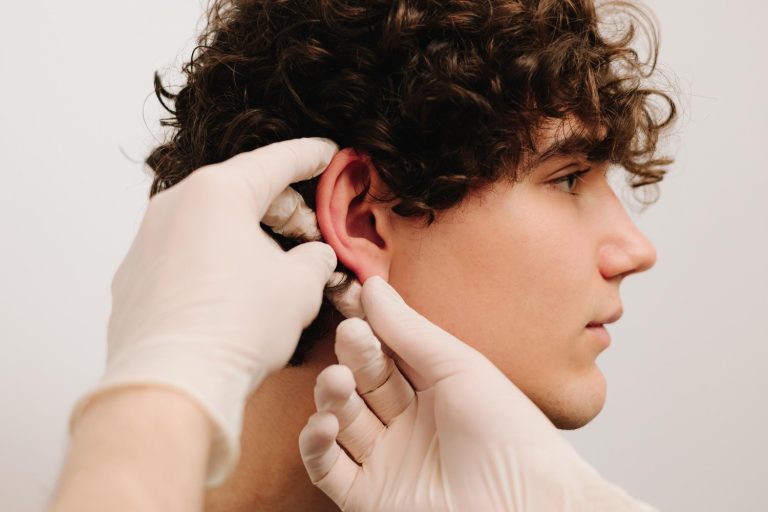
During otoplasty planning, the ear structure is analyzed in full detail. Just reducing the angle is not enough; Correct angulation in line with the antihelix that forms the ear folds and shaping in accordance with the cartilage structure is required. Each patient's ear and facial structure is different; Therefore, otoplasty is a personalized surgery.
The operation is usually performed under local anesthesia + sedation. It is a comfortable process, especially for adults. In children, general anesthesia is mostly preferred.
The surgery begins with a thin incision made behind the ear; In this way, the scar is hidden within the natural folds and becomes unnoticeable over time. By shaping the cartilage tissue, new folds are created or existing folds are clarified. The ear is positioned at a natural angle towards the head and its new position is supported with special stitches.
The aim of this procedure is not only to move the ears back, but also to provide a permanent and natural anatomical form. Cartilage tissue is not excessively damaged; Its natural curve and elasticity are preserved. The operation takes approximately 60-90 minutes.
Steps in brief
This modern approach does not make the ears look “glued on”; It gives a natural ear angle and curve.
After the surgery, a special bandage is applied to the ears and kept for about a week. Slight swelling and a feeling of tightness are normal in the first days. After the bandage, it is recommended to use sports tape or hair band for a while to protect the ears, especially when going to bed at night. Most patients return to their social life in a short time; The procedure is permanent and the scars fade over time.
Overall recovery timeline
The person is not only aesthetically pleasing; He also feels significant relief in social and psychological terms.
Things to Consider After Surgery
These simple steps help your recovery progress comfortably and healthily.
Protruding ear surgery is an aesthetic procedure that provides natural results and positively affects facial aesthetics and the person's self-confidence. With current surgical techniques, ear anatomy is preserved, natural folds are recreated, and a balanced appearance that is compatible with the face is achieved. With correct planning, experienced surgical approach and careful recovery process, the results last for many years.
Specialist in Aesthetic, Plastic, and Reconstructive Surgery
To receive detailed information about our procedures and to schedule an appointment, please fill out the form below.
You can send us an email or reach us by phone for more information.
Assoc. Prof. Dr. Beşir Öztürk, Specialist in Aesthetic, Plastic, and Reconstructive Surgery, combines the latest surgical techniques with years of experience to achieve natural, balanced, and aesthetic results.
Each procedure is carefully planned to reflect the best version of you and help you rediscover yourself.
