

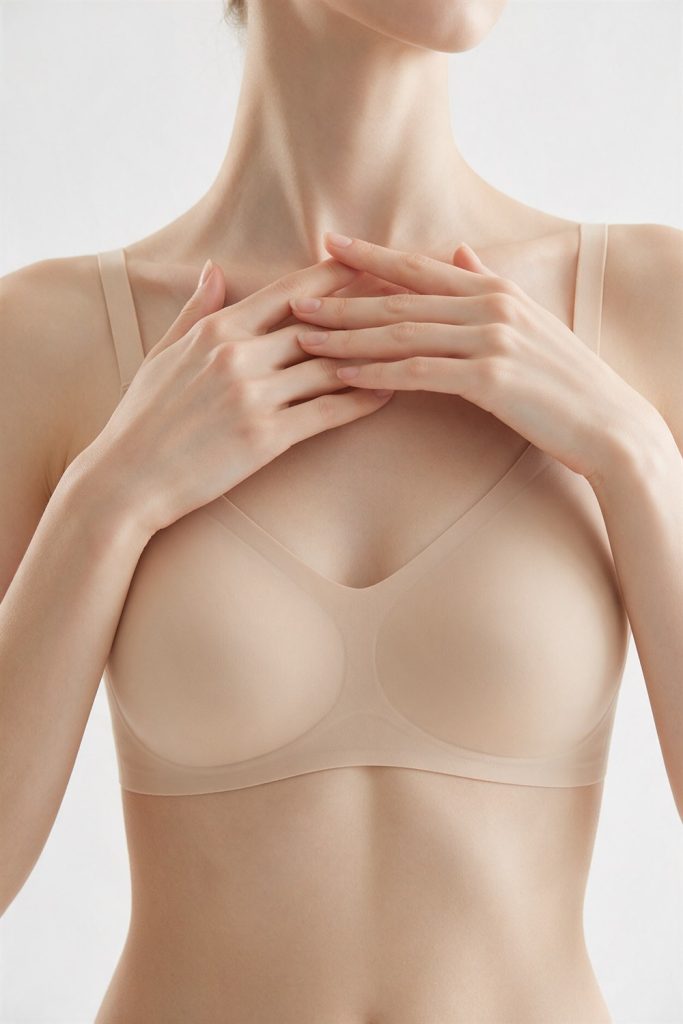
The Preservé Method for Breast Augmentation
Preservé (also known as the Preserve method) is a new-generation, tissue-preserving breast augmentation technique performed through a small incision in the fold beneath the breast. Developed by Establishment Labs, the manufacturer of Motiva implants, the method creates the implant pocket not by cutting the tissues but by gently separating them with a dedicated channel separator and an inflatable balloon. The aim is to achieve a natural-looking fullness while preserving, as far as possible, the breast gland, the nerves that carry nipple sensation and the ligament structures that give the breast its shape.
Treatment Summary
The following information is for general guidance purposes.
Exact durations and procedures are determined after individual evaluation.
Incision Length
3 - 4 cm
Return to Daily Life
Usually Within the First Week
Anesthesia
Sedation or General Anesthesia
Augmentation Range
Up to 4 Cup Sizes
Preservé is the second method in Establishment Labs’ minimally invasive product family after Mia Femtech, and it builds on the technologies developed for Mia. Unlike Mia, it is performed through the fold beneath the breast and has a wider range of use: the manufacturer defines the method for primary augmentations of up to four cup sizes, hybrid augmentations in which the implant is combined with fat grafting, and augmentations combined with a breast lift.
In conventional breast augmentation, the implant pocket is created beneath the breast gland or behind the chest muscle using sharp dissection or electrocautery. During this process, the ligaments, blood vessels and nerves that shape the breast can be affected. Preservé instead targets a space between the breast gland and the fascia of the chest muscle, made up of layers of fat and connective tissue. This space was described as the posterior intralamellar plane in an anatomical study published in 2026, in which 16 breasts from 8 cadavers were examined. The study showed that balloon expansion propagated along this plane and created a regular space without disrupting the breast gland or the nerves and blood vessels.
How Is the Preservé Method Performed?
Before surgery, measurements are taken and the implant size and pocket boundaries are planned. The procedure then continues in the following steps:
- Anesthesia: Depending on the patient and the extent of surgery, local anesthesia with sedation or general anesthesia is used. A tumescent anesthetic solution is infiltrated into the breast tissue.
- Incision: An incision of about 3-4 cm is made in the fold beneath the breast.
- Creating the channel: The Motiva Channel Separator advances through the layered space behind the breast gland without cutting the tissues.
- Creating the pocket: The Motiva Inflatable Balloon is introduced into this channel and gradually inflated to create a pocket that fits the implant.
- Placing the implant and closure: The implant is placed in front of the chest muscle and the layers are closed with sutures.
Because the chest muscle is neither cut nor lifted, animation deformity (a change in breast shape when the muscle contracts, which can occur with techniques that place the implant behind the muscle) is not expected.
Implants Used in Preservé
Preservé is performed with Motiva Ergonomix and Ergonomix2 implants. These implants have a finely textured surface called SmoothSilk and, according to the manufacturer, their shape adapts as the body changes position. In the study carried out at five centers in the United States, implants with mini, demi and full profiles were used, with volumes ranging from 150 to 315 cc.
The implant sits in front of the chest muscle (prepectoral), within the layered tissue behind the breast gland. The study authors state that these preserved layers form natural support around the implant.
Who Is a Suitable Candidate for the Preservé Method?
Preservé addresses a wider group of patients than Mia Femtech. The uses defined by the manufacturer are:
- Augmentation of up to four cup sizes in patients who have not had breast surgery before
- Hybrid breast augmentation, in which the implant is combined with fat grafting
- Breast augmentation combined with a breast lift
The ages of the patients in the US multicenter study ranged from 22 to 71 years (average 37). It is an option worth considering for women who want a natural-looking result, who value preserving nipple sensation or who do sports that place heavy demands on the chest muscles. For patients who want a smaller change and have no sagging, Mia Femtech, performed through the armpit, is also an option; when there is significant sagging, a breast lift may be considered. For patients who have had implant surgery before, the suitability of the method is assessed individually.
Recovery After Preservé
The aim of Preservé is to make recovery easier by reducing trauma to the tissues. In the US multicenter study, patients reported returning to daily life as follows:
- 17% within 1-3 hours after surgery
- 33% one day after surgery
- 31% within 3-5 days
- 12% within 1 week
- 7% after more than 1 week
In other words, about 93% of patients returned to their daily activities within the first week. The use of a support bra and the timing of your return to work and exercise are planned individually according to the extent of surgery (for example, whether it was combined with a breast lift).
Clinical Study Results
The first clinical data on Preservé were published in September 2026 in a supplement of the Aesthetic Surgery Journal dedicated to breast tissue preservation.
US multicenter study: 161 patients were operated on at five centers; 159 were included in the analysis and followed for an average of 5 months.
- No hematoma, loss of sensation, sensory disturbance, abnormal pain or capsular contracture was observed.
- Complications occurred in 3 patients in total: one patient required an additional procedure to salvage the implant because of an early infection, one patient developed rippling, and in one patient an implant that was high at 3 weeks settled on its own.
- 94% of patients said they were satisfied with the overall appearance of their breasts, and 98% with how they feel and move.
12-month study in Costa Rica: In the 12-month results of 111 patients treated with Mia and Preservé (37 with Mia, 74 with Preservé), the overall complication rate was 4.5%. No capsular contracture (Baker III-IV), implant rupture or loss of nipple sensation was reported.
Although these data are positive, follow-up times are still short. As noted in the accompanying editorial, problems such as capsular contracture, implant malposition and changes in size may not fully appear within 6-12 months. The study authors have financial ties to Establishment Labs, and long-term studies from independent centers will define the place of the method more clearly.
Frequently Asked Questions
What is the difference between Preservé and Mia Femtech?
Both methods are based on creating the pocket with a balloon without cutting the tissues. Mia Femtech is performed through the armpit, mostly under local anesthesia and sedation, and is designed for small to moderate augmentation. Preservé is performed through the fold beneath the breast and allows augmentation of up to four cup sizes as well as surgery combined with a breast lift.
Where will the scar be?
The incision is about 3-4 cm long and lies in the fold beneath the breast. The scar fades over time and remains largely hidden within the fold.
Can I breastfeed after surgery?
In Preservé, the breast gland and milk ducts are not cut, and the implant is placed behind the breast gland. The technique is therefore not expected to prevent breastfeeding; even so, it is important to discuss your pregnancy plans during the consultation.
When can I return to sport?
The timing of your return to sport is planned individually according to the extent of surgery. Because the chest muscle is neither cut nor lifted, the aim is to preserve muscle function.
Personalized Planning for Preservé
Like any surgery, Preservé carries risks such as infection, implant displacement, asymmetry, rippling and capsular contracture. Data on the long-term results of the method are still accumulating.
At the first consultation, we assess your expectations, breast measurements, tissue thickness and degree of sagging together. After this assessment, we decide together whether Preservé, Mia Femtech or a conventional method is the most suitable option for you.
Scientific References
- Pittman TA, Steve A, Zeidler K, Chidester JR, Calobrace MB. Minimally Invasive, Tissue-Preserving Breast Augmentation: Insights From a Large Case Series, Technique and Surgical Pearls. Aesthetic Surgery Journal. 2026;46(Suppl 2):S117-S126. doi:10.1093/asj/sjag113
- Chacon-Quiros M, et al. Retrospective Validation of a Tissue-Preserving Breast Augmentation Approach: From Native Tissue Geometry to Surgical Practice. Aesthetic Surgery Journal. 2026;46(Suppl 2):S127-S137. doi:10.1093/asj/sjag110
- Lhuaire M, et al. Anatomical Basis of a Posterior Intralamellar Plane in Breast Tissue-Preservation Surgery. Aesthetic Surgery Journal. 2026;46(Suppl 2):S109-S116. doi:10.1093/asj/sjag059
- Graf R, LeBlanc D. Tissue Preservation in Primary Breast Augmentation: From Founding Concepts to Early Evidence. Aesthetic Surgery Journal. 2026;46(Suppl 2):S93-S95. doi:10.1093/asj/sjag114
